

Transforming Reading for SEND Learners: The Power of Text‑to‑Speech
Why Text-to-Speech is an Essential Tool for Inclusive Education
Across the UK, literacy remains a significant challenge. The National Literacy Trust reports that 1 in 6 adults in England have “very poor literacy skills” (National Literacy Trust, 2023), and many children struggle to access texts at the level required by the curriculum. For pupils with special educational needs and disabilities (SEND) - including dyslexia, ADHD, autism and vision impairments – reading traditional printed material can be a barrier to learning. It may also impact reading confidence and wellbeing.
As schools work to build inclusive learning environments, assistive technology is a helpful addition to all classrooms. It should be a core part of equitable teaching and learning. Among these tools, Text‑to‑Speech (TTS) stands out as one of the most impactful and easy‑to‑implement solutions.
TTS technology transforms written text into spoken words. It enables learners to access books, worksheets, online resources and revision and exam materials in a way that suits their needs. When used well, TTS supports reading, boosts independence and helps neurodivergent learners thrive.
What Text‑to‑Speech Actually Does and Why It Works
Text to Speech (TTS) reads digital text aloud using synthetic speech. Modern TTS voices are natural-sounding and expressive. While the older ‘robotic’ voices are still available, with some young people preferring them, a range of male and female voices, regional accents and expressive intonations are available.
The educational value of TTS is grounded in cognitive science. Research shows that listening comprehension develops earlier than reading comprehension and remains stronger for many learners, including those with dyslexia (Hogan, Adlof & Alonzo, 2014). When decoding is difficult, pupils often expend so much cognitive effort on recognising words that they have little capacity left for understanding the meaning.
TTS reduces this cognitive load. By reading text aloud, it allows learners to focus on comprehension, vocabulary and content knowledge - the parts of reading that matter most for learning.
Studies also show that TTS can improve reading accuracy and fluency. This can help improve motivation to read for students with reading difficulties(Wood et al., University of Oxford, 2018). For many pupils, it transforms reading from a source of stress into a manageable, even enjoyable, activity.
Benefits of Text to Speech for readers and learners with additional needs
Dyslexia and other print-based disabilities
Dyslexia affects around 10% of the UK population (British Dyslexia Association, 2023). For dyslexic learners, decoding text be slower and exhausting. Text to Speech provides immediate access to grade‑level content without the barriers print can produce.
Benefits include:
- Reduced decoding fatigue
- Improved comprehension
- Increased reading volume
- Greater confidence and independence
Bookshare USA shares numerous stories of dyslexic students who discovered a love of reading once they could listen to books. One student, Lily, described how audiobooks and TTS “opened up the world of stories” after years of frustration with print (Bookshare, 2022).
ADHD and executive‑Function
Pupils with ADHD can struggle with sustained attention, working memory, and organisation. TTS supports reading by:
- Providing multimodal input (visual + auditory)
- Helping maintain focus
- Reducing the effort required to track text
- Supporting independent study and homework
The ADHD Foundation notes that multimodal learning approaches significantly improve engagement for neurodivergent learners (ADHD Foundation, 2023).
Vision impairments and low vision
For learners with vision impairments, Text to Speech is an essential tool. Screen readers and magnification tools allow pupils to access the same materials as their peers.
Dolphin Screen Reader and SuperNova are widely used in UK schools to support blind and partially sighted learners. This assistive technology enables students with vision impairments to navigate digital content, read textbooks and complete assignments independently.
Autistic and other neurodivergent learners
Some students with autism may find reading print overwhelming or difficult. Issues may be triggered by sensory sensitivities, anxiety around reading aloud or other factors. TTS can:
- Provide predictable, calm reading experiences
- Reduce anxiety
- Support comprehension through consistent pacing
- Allow learners to choose their preferred reading voice
- Allow readers to control the volume and speed of the reading voice
This flexibility can help neurodivergent learners engage with reading in ways that feel helpful, safe and manageable.
TTS as a tool for wellbeing and confidence
Reading difficulties can have a profound impact on self‑esteem. The National Literacy Trust highlights that children who enjoy reading are three times more likely to have good mental wellbeing (National Literacy Trust,2018). Yet many learners with additional needs associate reading with failure or embarrassment.
TTS helps break this cycle by:
- Removing or reducing instances of ‘falling behind’ in class
- Allowing learners to independently access the same books as their peers
- Supporting success in class discussions
- Encouraging reading for pleasure and wider reading
- Enabling reading in class and at home
When pupils feel capable, their confidence grows and so does their willingness to read.
TTS in the Classroom: Practical benefits for teachers and parents
For educators, Text to Speech is a powerful tool for inclusive teaching. It supports differentiation without creating extra workload.
Classroom benefits include:
- Enabling all pupils to access the same text in a way they find accessible
- Supporting independent learning
- Reducing the need for 1:1 adult support
- Helping pupils complete reading tasks at their own pace
- Making homework more manageable
Parents also report that Text to Speech use reduces conflict around reading at home. Instead of battles over decoding the words on paper, TTS helps families focus on understanding the written word and enjoying books and stories together!
The role of accessible libraries and platforms
TTS becomes even more effective when paired with accessible digital libraries:
RNIB Bookshare (UK)
RNIB Bookshare Education Collection provides over 1 million accessible curriculum titles for learners with print disabilities, including dyslexia and vision impairment.
Using EasyReader Education, teachers can assign books available in RNIB Bookshare. Teaching teams can monitor reading activities and engagement, this helps identify areas where additional support may be needed.
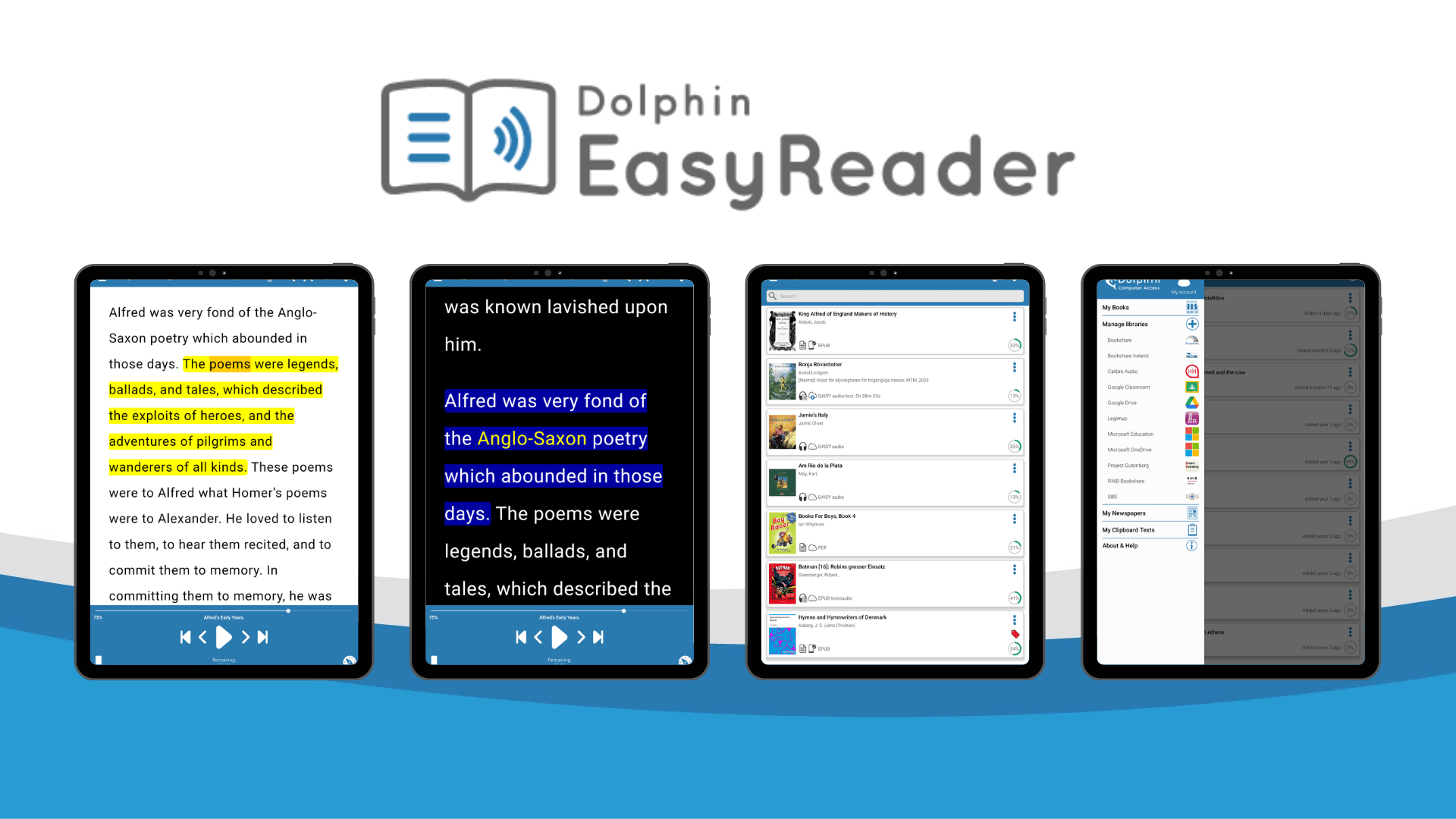
Students can use TTS to read and enjoy books and other reading material in the Dolphin EasyReader app.
Bookshare (USA)
Bookshare USA offers a similar library service across the USA and Canada. Their case studies show how accessible formats transform learning for dyslexic and visually impaired students.
Other libraries and book collections are available, with versions of books and other reading material in formats which are accessible to people with vision impairments, dyslexia and any other print impairments. These libraries provide opportunities for more people to browse and choose their reading material, while EasyReader provides the means to download, read and enjoy books and stories.
Accessible libraries:
- Expand reading choice
- Support curriculum access
- Encourage reading for pleasure
- Reduce the cost of specialist materials
When combined with TTS, they give learners with special educational needs and disabilities the freedom to read independently and confidently.

Spotlight on Solutions: EasyReader App & EasyReader Education
While many tools offer TTS, EasyReader stands out for its focus on accessibility, inclusion and ease of use.
EasyReader App
EasyReader is designed specifically for readers with dyslexia, vision impairment and other print disabilities. It offers:
- High‑quality TTS voices
- Customisable text settings (font, spacing, colours)
- Synchronised text highlighting
- Simple navigation
- Direct access to RNIB Bookshare and other accessible libraries
This combination makes reading more accessible, enjoyable and a personalised experience for every reader.
What your school can do with EasyReader Education
EasyReader Education provides a whole‑school accessible reading solution. It allows teachers to:
- Manage access for all students
- Assign books from RNIB Bookshare
- Support SEND learners
- Embed accessible reading into everyday teaching
Because it works for dyslexic, neurodivergent, visually impaired and other learners with additional needs, it becomes a universal tool for inclusion.
Dolphin’s wider assistive technology products include SuperNova magnification and screen reading software, which supports pupils with vision impairments, but EasyReader Education is the platform that brings accessible reading to the entire school community. It makes reading more accessible for any student that your teaching team thinks would benefit.
Conclusion: A call for schools to adopt TTS as standard practice
Text to Speech should be considered a vital part of inclusive education. For dyslexic, neurodivergent, visually impaired and other learners with SEND, it opens the door to independent reading, learning and participation.
The evidence is clear:
- TTS improves comprehension and fluency
- It reduces stress and boosts wellbeing
- It supports independence and confidence
- It enables equitable access to the curriculum
- It encourages reading for pleasure
As schools strive to meet the needs of diverse learners, TTS can be a standard part of every classroom’s accessibility toolkit.
Try EasyReader Education
EasyReader Education offers a simple, effective way to introduce TTS and accessible reading across a whole school, college or university.
With additional features that also enable students to read along with highlighted text on screen, which is synchronised with the TTS audio, EasyReader Education benefits more of your students, so they can read, study and revise in ways that work for them.
Adopting it in your classrooms means educators can ensure that every student - regardless of their reading needs or official diagnoses - has the opportunity to learn and thrive, while discovering their own love of reading.
Contact the team at Dolphin on 01905 754 577 to learn how EasyReader Education can help the young people in your setting, or try EasyReader Education free for 30 days.


Let Us Know What You Thought about this Post.
Write your comment below.